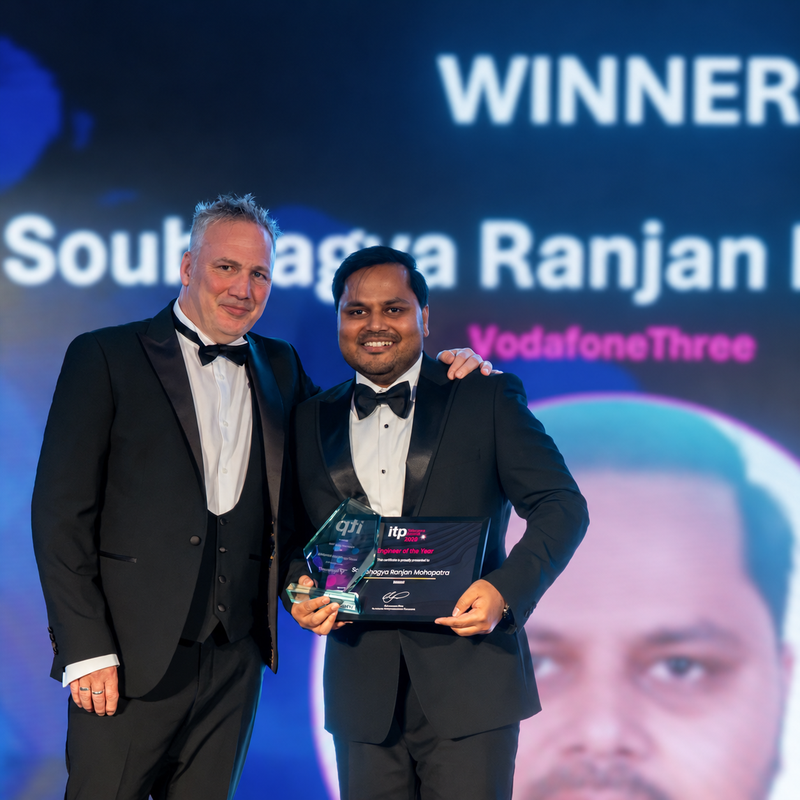
Meet the ITP’s 2026 Engineer of the Year Winner – Soubhagya Ranjan Mohapatra, VodafoneThree
1. What first sparked your interest in engineering, and what led you into mobile networks?
I was always drawn to how things connect literally and figuratively. Mobile networks felt like the most tangible expression of that: invisible infrastructure that billions of people depend on every day without thinking about it. That tension between complexity and invisibility is what keeps it interesting 18 years on.
2. Your career has taken you across multiple countries and very different networks. Which experience most changed the way you approach engineering, and why?
Working across Asia, the Middle East and Europe taught me that network problems are rarely just technical. The constraints are cultural, commercial and political as much as they are engineering. That perspective has been invaluable in the VodafoneThree merger understanding that the hardest part of integrating two networks is rarely the radio layer.
3. Much of your work happens behind the scenes but affects millions of people. What's one example of something customers experience every day that your engineering helps make possible?
When you walk into a building and your call doesn't drop, or your video keeps playing that's the result of hundreds of small design decisions about how the network hands off between cells and frequencies. It's entirely invisible when it works, which is exactly how it should be.
4. Your GreenRAN work uses AI to reduce network energy consumption. How do you save power while ensuring customers still get the service they need?
The key insight is that demand is not constant a cell site at 3am needs far less capacity than at 8am. GreenRAN uses AI to dial network components up and down in response to real demand, rather than running everything at full power around the clock. The work is in defining the thresholds carefully so quality is never compromised. What surprised me most was how significant the savings were once we got the parameters right.
5. What advice would you give an engineer starting out today, and which skills do you think will matter most as networks evolve?
Learn how to explain what you do to someone who isn't an engineer. The technical skills will evolve 5G will give way to 6G, AI tooling will change but the ability to translate complexity into clear decisions is timeless. Also: work across vendors and technologies as early as you can. Breadth compounds.
6. What does winning this award mean to you personally, and what engineering challenge would you most like to tackle next?
I was genuinely overwhelmed. Standing on that stage, holding the award it took a moment to sink in. I've dedicated nearly two decades to this industry and to hear that recognised in this way means everything. I'm incredibly proud, not just for myself but for everyone I've worked alongside who made that work possible.
As for what's next the engineering challenges that excite me most are the ones where the complexity is completely hidden from the end user. Making networks smarter, greener and more resilient while the person on the other end simply gets a better experience. There's still a lot of work to do there and I'm glad to be in the middle of it.